Making a pile of wood in the wild garden, could be a good idea. As well as dry stone walls and piles of stone, the spaces that are shaped are an excellent shelter for many animal species, mainly for smaller ones such as insects, spiders, amphibians, reptiles, etc.
In addition, the decaying wood represents a real treasure of biodiversity. For this reason, when a tree falls or dies, it would always be useful to leave it in its place (obviously if it does not represent a safety problem!) as it can offer shelter and food to several animal species.
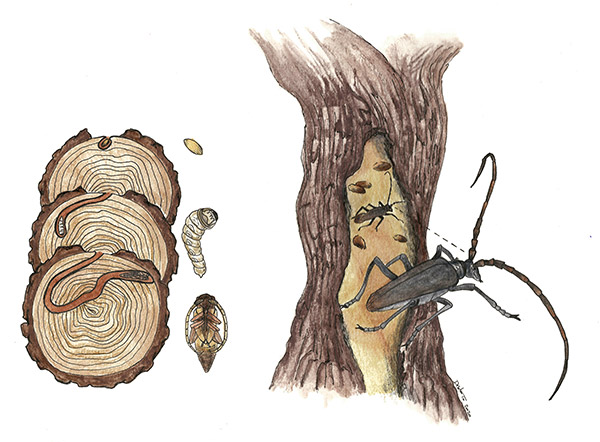
Just think of the xylophagous beetles (the insects that feed on wood) such as the great capricorn beetle (Cerambyx cerdo), whose life cycle is closely linked to the presence of rotting wood: The eggs, laid under the bark of old trees, generate the larvae which feed on the fibres of the wood. The larva takes three years to complete its development, digging large tunnels a few centimetres wide, and obtaining at the end a large cell where it turns into nymph. After almost a year, it will flit and become an adult who will continue to visit the trees where it has developed, not moving far away from them.
Other species too, even if their vital cycle is not so closely connected to the presence of dead wood, find shelter in the old trees fallen on the ground, and in the piles of wood. Reptiles will use it as a site for thermoregulation (you’ll find out more in the next pages) but also to go into hibernation during the winter. Amphibians hosted in your pond will find shelter there, both in the hottest days (as a site of aestivation) that in the coldest ones (as a site of hibernation). The same goes for hedgehogs and many other small mammals!